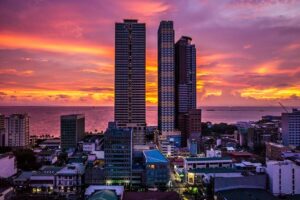
Most guides give Intramuros two hours. They send you in through the main gate, point at Fort Santiago, hustle you past the cathedral, and herd you back onto the bus before lunch. If you actually want to walk the place, you need a half day at minimum.
Intramuros is the original Manila: Spanish stone, four gates, a moat mostly gone, a UNESCO-listed church that survived the worst urban battle of the Pacific war. The area is sixty-four hectares, which sounds small until you factor in the museums, the dungeons, and the fact that you’ll stop every hundred metres to read a marker.

This guide includes affiliate links to tours and accommodation. If you book through them I get a small commission at no extra cost to you, which keeps the lights on at TravelToManila.net.
In This Article
- What Intramuros Actually Is
- Walking Route at a Glance
- Plaza Roma
- Manila Cathedral
- Casa Manila
- San Agustin Church and Museum
- The Church
- The Museum (the part most tourists skip)
- Plaza San Luis
- Baluarte de San Diego
- Fort Santiago and the Rizal Shrine
- The Rizal Shrine
- The Dungeons and the White Cross
- The Dungeons and the White Cross
- The River Promenade
- Practical Visit
- Fees and Hours, Quick Reference
- Kalesa Rides: Read This Before You Get In
- Bambike Eco-Tours
- When to Go
- Where to Eat Inside vs Outside the Walls
- Getting In From Makati, BGC, and Pasay
- What Survived the Battle of Manila
- The Walls and the American Demolition
- Skip This / Don’t Skip
- What to Pair It With
- Frequently Asked Questions
- How long does Intramuros take to see properly?
- Is Intramuros safe to walk?
- Can I do Intramuros without a guide?
- What is the fair price for a kalesa ride?
- What should I wear?
- Can I visit Intramuros at night?
- How much should I budget?
What Intramuros Actually Is
The Spanish broke ground in 1571 on the south bank of the Pasig, on the spot where a Muslim trading settlement called Maynila already stood. The walled city became the political, religious and military centre of three centuries of Spanish rule. Inside sat the governor’s palace, the cathedral, San Agustin Church, the colleges, the Manila mint, and a tight grid of stone houses with sliding capiz windows. The name is Latin: intra muros, “within the walls.”
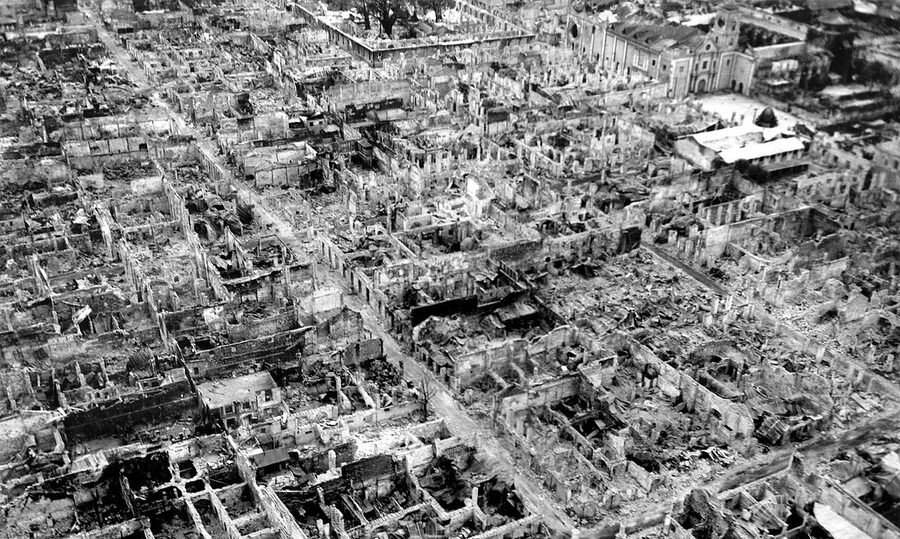
Almost all of that is gone. The Battle of Manila in February and March 1945 levelled the district; six of the seven major churches were rubble. Most of what you see today is reconstruction by the Intramuros Administration, set up in 1979. The grid is original. The walls are largely original. Most buildings standing on top are not. That gap between what was here and what’s here now is the whole point.
Walking Route at a Glance
The route below is what I’d hand a friend who flew in this morning. Two and a half kilometres total, eight stops, half a day if you read the museums. I prefer walking it south to north so you finish at Fort Santiago in the late afternoon, when the light hits the gate.
- Plaza Roma: the original main square; ten minutes
- Manila Cathedral: Byzantine-Romanesque, eighth structure on the same lot; thirty minutes
- Casa Manila: colonial-mansion replica; thirty to forty minutes
- San Agustin Church and Museum: UNESCO, the only church that stayed standing in 1945; ninety minutes
- Plaza San Luis: restored heritage block; fifteen minutes
- Baluarte de San Diego: circular bastion ruin; twenty minutes
- Fort Santiago and Rizal Shrine: gardens, museum, dungeons; ninety to one hundred and twenty minutes
- Pasig River promenade: sunset and the night market; flexible
If you’re starting from Makati or BGC, allow forty-five minutes by Grab in moderate traffic, twice that at rush hour. See getting around Manila for transport. If you’re staying nearby, The Manila Hotel is a five-minute walk to the western gate.
Plaza Roma
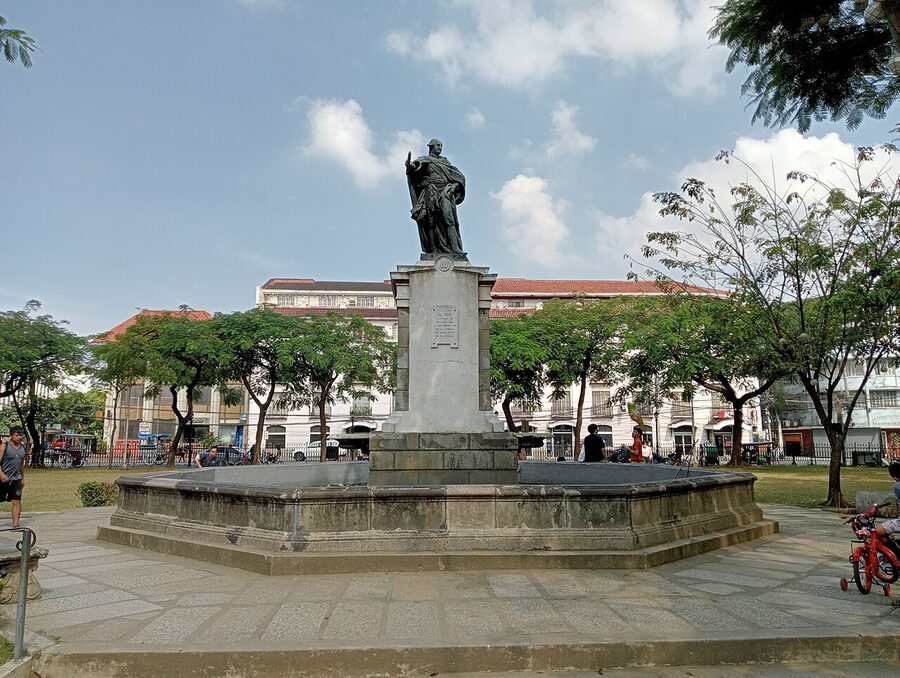
Start here because it’s where the Spanish started. Plaza Roma was the ceremonial heart of Spanish Manila, framed by the cathedral, the archbishop’s palace, and the Ayuntamiento. The statue is Carlos IV, who sent the smallpox vaccine to the Philippines in 1804 in what was probably the first global vaccination campaign. For a century the square was also the bullring; the benches went all the way up the walls of the cathedral plaza. The kind of detail you only get if you stop and read.
Manila Cathedral
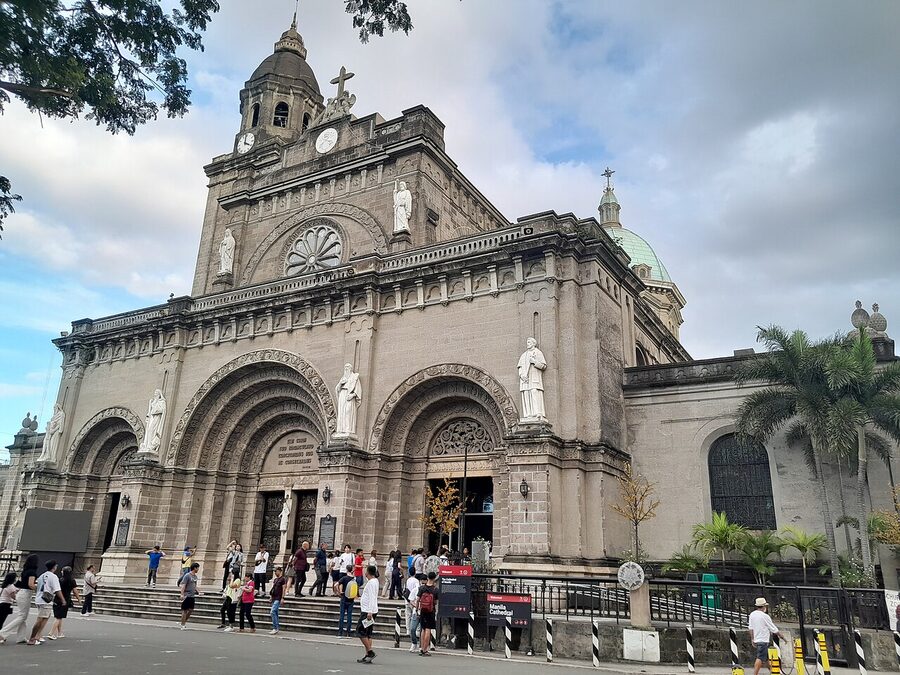
The Cathedral has been destroyed and rebuilt seven times since 1581; earthquakes took most of them. The seventh, a Spanish-Filipino structure with twin bell towers, was flattened in February 1945. The version you see now is a 1958 Byzantine-Romanesque rebuild by Filipino architect Fernando Ocampo. Entrance is free; open most days 7am-6pm. If the doors are closed on a Saturday afternoon, it’s almost always a wedding.
Inside, look up at the central dome and the rose window. The stained glass is post-war, designed by Filipino artist Galo Ocampo. The pipe organ has more than four thousand pipes. One thing nobody mentions: the marble floor is the most reliable air-conditioning in Intramuros. Locals come to sit and escape the heat for ten minutes. You should too.
Casa Manila
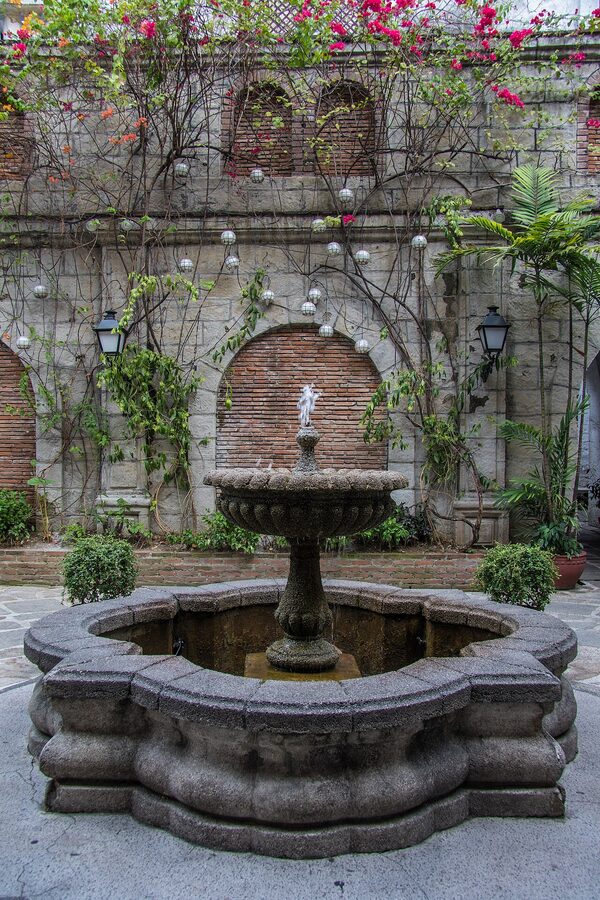
Casa Manila is a reproduction of an 1850s upper-class Spanish-Filipino townhouse, built by Imelda Marcos’s Intramuros Administration in the early 1980s on the site of a real one. It’s not original. Critics call it a colonial Disneyland. They have a point.
That said, it’s the only place in Manila where you can walk through a fully furnished bahay na bato, the stone-and-wood houses that filled the walled city before 1945. Ground floor for storage and stables, mezzanine for staff, second floor for the family, with the formal sala opening onto sliding capiz windows. The dining room sets a long mahogany table for twelve. The bedroom has the famous two-seater latrine (apparently even the most private moments were better shared).
Hours: Tuesday to Sunday, 9am to 6pm. Closed Mondays. Entry: ₱75 per person.
Casa Manila is overrated for what it is. If you’ve seen any heritage house in Vigan or Taal, you’ve seen better, with original furniture and original walls. Casa Manila is a teaching tool, not a treasure house. Spend twenty-five minutes, take the courtyard photo, move on. If you only have one hour and you’re choosing between Casa Manila and the San Agustin Museum next door, choose the museum every time.
San Agustin Church and Museum
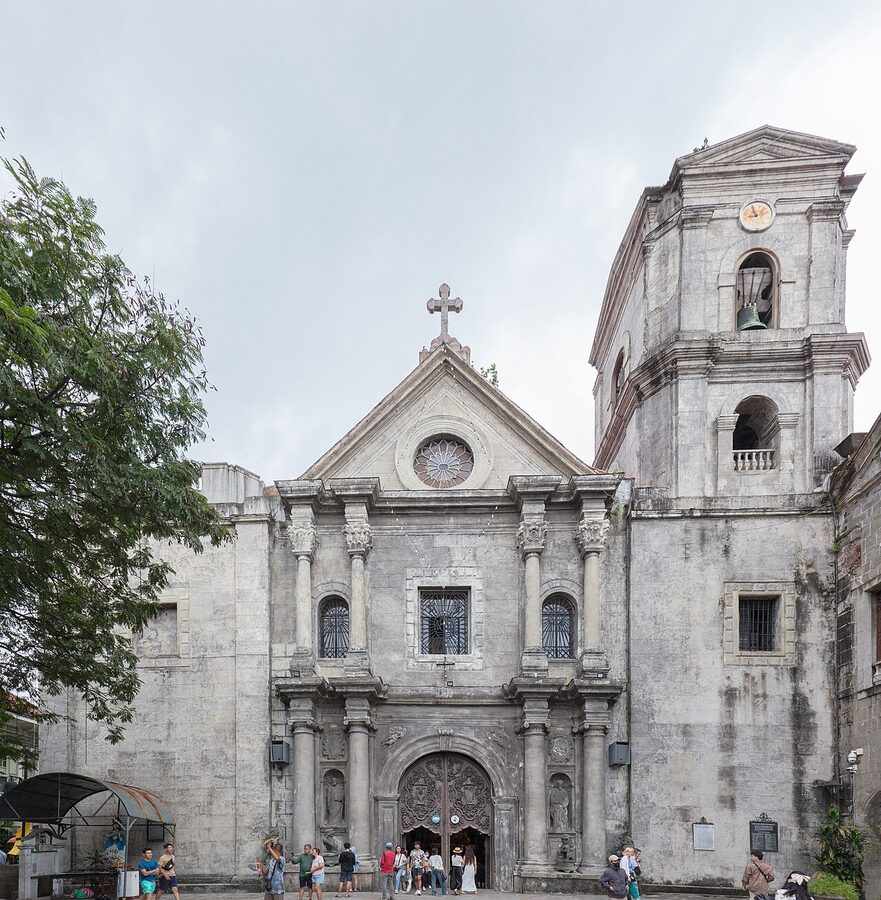
This is the one. If you only see one building inside the walls, see this one. San Agustin was built between 1586 and 1606, making it the oldest stone church in the country. It survived four earthquakes (the catastrophic 1645 and 1863 ones included), the British occupation of Manila in 1762, and the Battle of Manila in 1945. When American forces finally broke through, San Agustin was the only major structure inside Intramuros still standing. Some Filipinos take that as divine protection. The Augustinians, who have been here continuously since 1571, certainly do. It’s a UNESCO World Heritage Site as one of the four Baroque Churches of the Philippines, inscribed in 1993.
The Church
The interior is more dramatic than the austere stone facade suggests. The trompe-l’oeil ceiling, painted in 1875 by Italian artists Cesare Alberoni and Giovanni Dibella, fakes coffered relief so convincingly most people don’t realise it’s flat. To the left of the main altar is the tomb of Miguel López de Legazpi, the conquistador who founded Spanish Manila in 1571. San Agustin is the prestige Catholic wedding venue in Manila; if a ceremony is on, the gates close. Entry is free.
The Museum (the part most tourists skip)
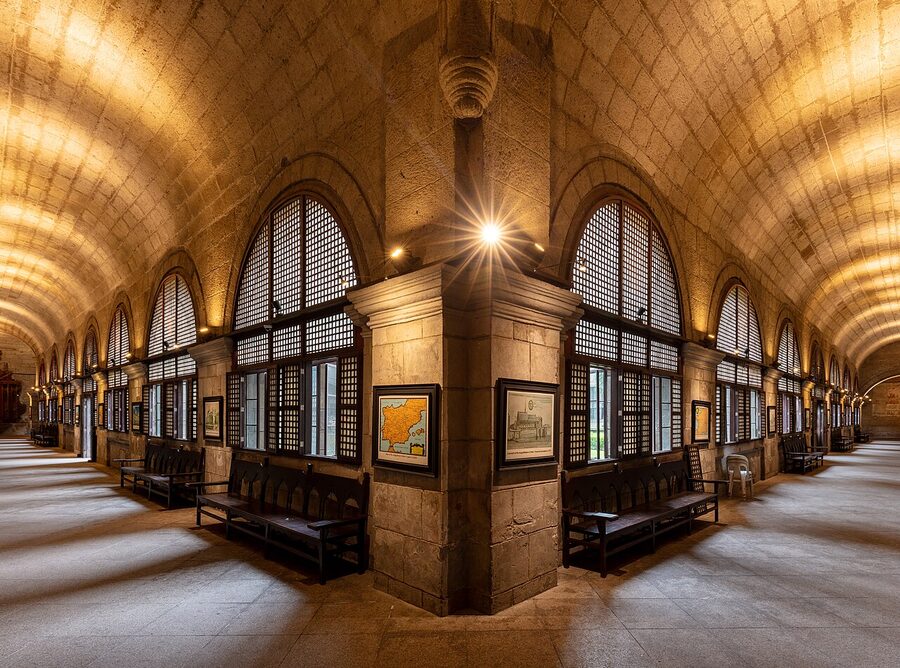
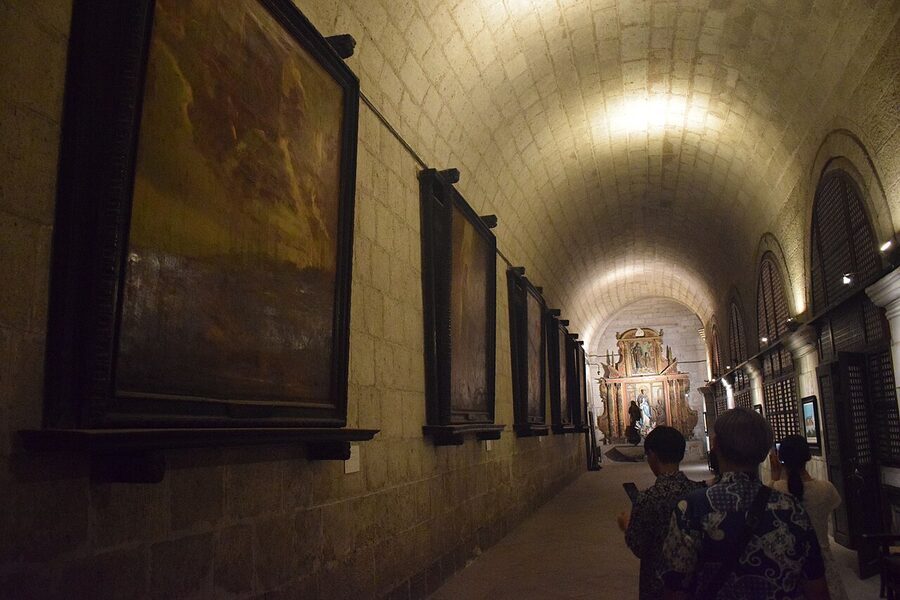
The adjoining monastery, also seventeenth century, has been a museum since 1973. The collection covers four centuries of Spanish-era religious art: ivory Virgin-and-Child carvings, vestments, illuminated choir books, sixteenth-century missionary maps. The cloister upstairs is one of the most peaceful spaces in Manila and almost nobody else is up there. Hours: Daily 8am-12pm and 1pm-5pm (the lunchtime closure is real). Entry: ₱200 (~$3.50). Worth every centavo.
Plaza San Luis
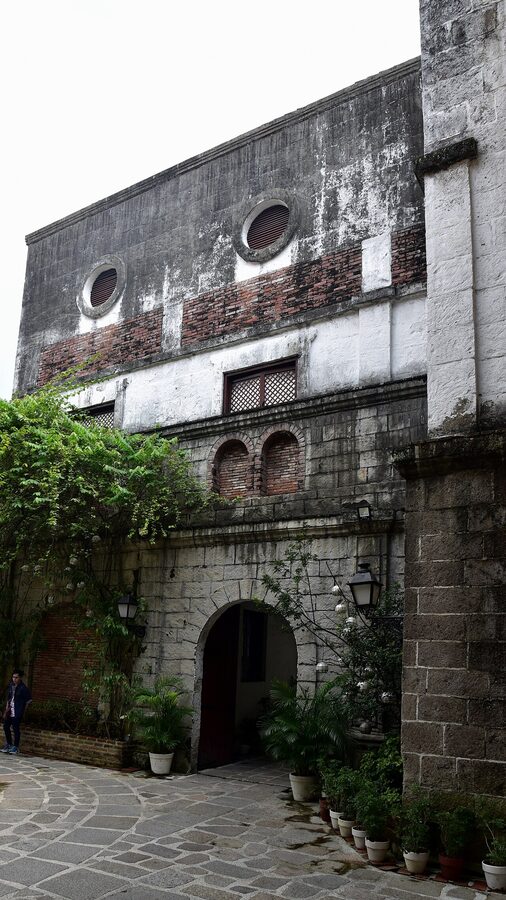
Across General Luna Street from San Agustin sits the Plaza San Luis Complex: a single block of five reconstructed nineteenth-century houses, each named after a real Spanish colonial residence that once stood in Manila. Casa Manila is the centrepiece (you’ve already done that). The rest are working buildings: cafés on the ground floors, offices upstairs, and Silahis Center on the corner for handicrafts that aren’t all junk. Fifteen minutes is plenty.
Baluarte de San Diego
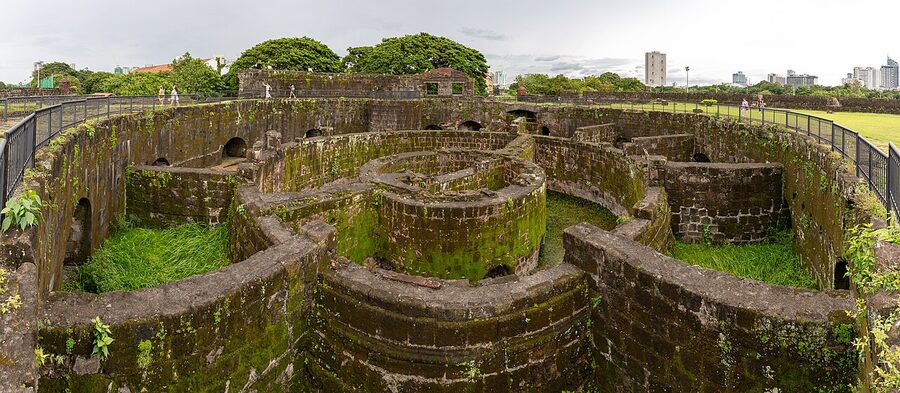
This one is genuinely strange and almost everybody walks past it. Baluarte de San Diego is the southernmost bastion on the wall. The original circular tower was built in 1587 (the first stone fortification the Spanish ever built in the Philippines), brought down by an earthquake in 1644, replaced by the larger pointed bastion you see today, and at some point buried under earth and forgotten for two centuries. The Intramuros Administration dug it back out in 1979.
So what you walk through now is a bastion within a bastion: modern pointed walls on the outside, the older circular ruin sunk in the middle, a garden with a fountain laid over both, and an underground gallery with a cannon. Best stop on a hot day; fewer than a dozen other people will be here.
Hours: Daily 8am-5pm. Entry: ₱75.
Fort Santiago and the Rizal Shrine
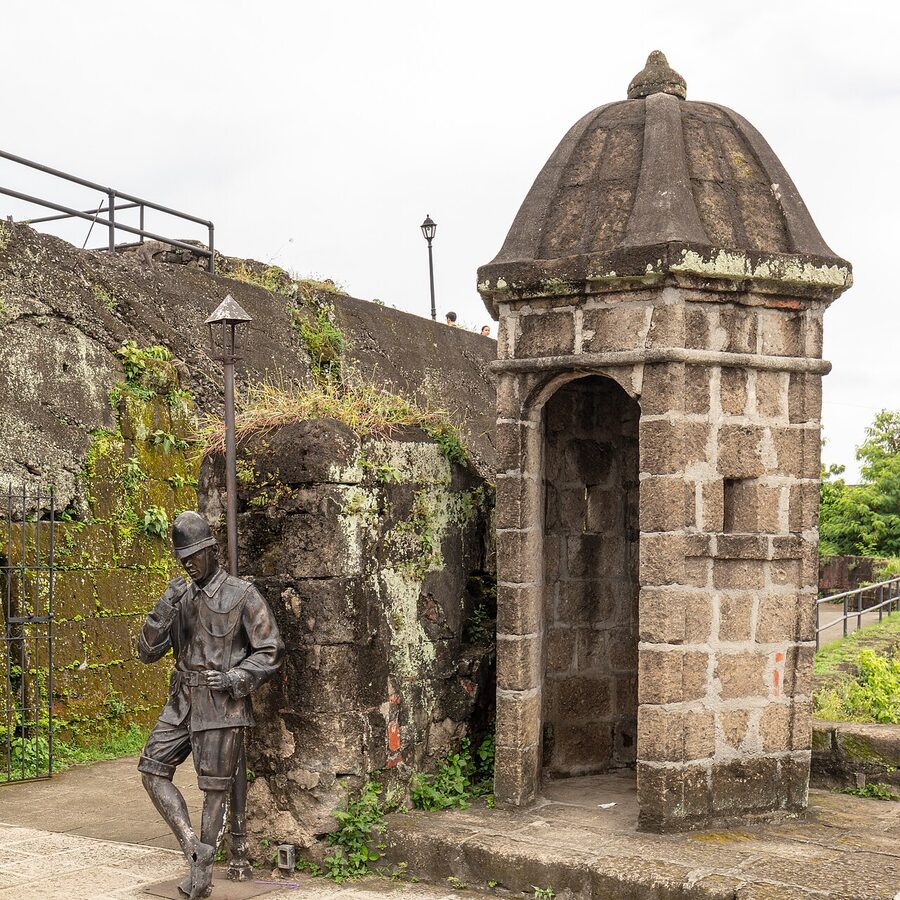
Save Fort Santiago for last and give it a full ninety minutes. This is the citadel guarding the mouth of the Pasig and the most layered site in the walled city. It’s where Rizal spent his final fifty-six days. It’s where six hundred civilians and POWs were murdered or starved in February 1945. It’s also where the gardens are now full of brides and kids on the lawn, and that contrast is the point.
You enter through Plaza Moriones, the soldiers’ old parade ground. The famous gate, with its relief of Santiago Matamoros (Saint James the Moor-slayer, patron saint of Spain), was destroyed in 1945 and rebuilt. Pick up the free map from the information centre; the layout is non-obvious without it. Past the gate is Plaza de Armas. The Rizal Shrine sits on the right.
The Rizal Shrine
José Rizal, the country’s national hero, was held here from 3 November to 29 December 1896 on charges of inciting rebellion through his novels Noli Me Tangere and El Filibusterismo. He was a polymath: doctor, ophthalmologist, novelist, sculptor, fluent in twenty-two languages. The museum walks you through it. You see his medical instruments, his sketches, the white linen suit he wore to his execution, and the chapel-cell where he married Josephine Bracken on the morning of 30 December 1896 before being marched out to Bagumbayan to be shot. He wrote “Mi último adiós” (Farewell) in the cell the night before. The museum has the original. If you’re new to Filipino history, this room will land harder than you expect. Rizal was thirty-five years old.
The Dungeons and the White Cross
The Dungeons and the White Cross
South of the plaza, stone steps lead down into damp chambers built into the river-side wall. The Spanish used them as powder magazines until the damp ruined gunpowder; then they became cells, and the cells held political prisoners through every regime that followed. In February 1945, retreating Japanese troops locked roughly six hundred Filipino civilians and POWs into these chambers. The Pasig flooded the lower cells. The rest suffocated, starved, or were killed. American liberators found the bodies in March. The mass grave is outside, marked by a white marble cross. Nobody talks much walking through here. You shouldn’t either. This is the harder half of the visit, and the part that makes the rest of Intramuros mean what it means.
The River Promenade
Climb back up to the riverside walk. The Pasig is brown and slow and historically the city’s main artery; rice and gold once moved up it from the interior, and traders from Brunei, Borneo and southern China tied their boats here. The view across to Binondo is unimpressive in daylight, but at sunset the bridge lights come on and the whole thing softens. Quiapo and the Quiapo street-food stalls are a five-minute walk over Jones Bridge.
Fort Santiago hours: Mon-Fri 8am-10pm; Sat-Sun 6am-10pm. Entry: ₱75 (~$1.30).
Practical Visit
Fees and Hours, Quick Reference
Entry to Intramuros itself is free. The ticketed sites:
- Fort Santiago: ₱75. Mon-Fri 8am-10pm; Sat-Sun 6am-10pm.
- Casa Manila: ₱75. Tue-Sun 9am-6pm.
- San Agustin Museum: ₱200. Daily 8am-12pm and 1pm-5pm.
- Baluarte de San Diego: ₱75. Daily 8am-5pm.
- Manila Cathedral and San Agustin Church (interior): Free; 7am-6pm.
- Intramuros Pass: ₱350 covers Fort Santiago + Casa Manila + Baluarte. Skip it. Buying separately is the same total and gives you flexibility.
Kalesa Rides: Read This Before You Get In
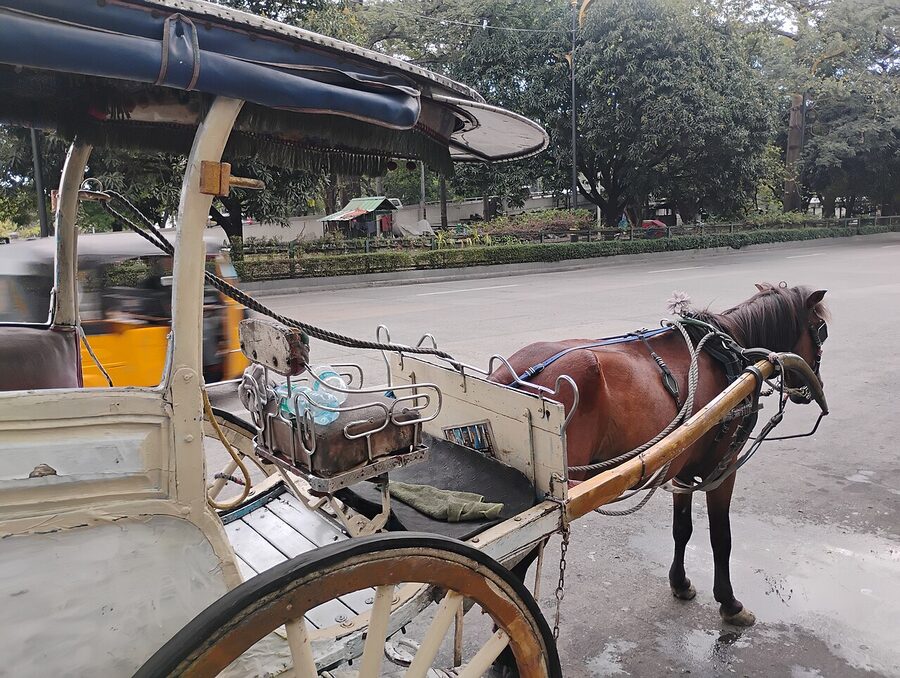
The horse-drawn carriages parked outside the gates are kalesas, a Spanish-era leftover. Drivers will quote you ₱1,500 for half an hour, sometimes ₱2,500. Smile, walk away, and find another driver. The fair price for a thirty- to forty-minute loop is ₱350-500 (~$6-9), and the experienced drivers know it. Negotiate hard, agree on the route and time before you climb in, pay only at the end. The horses live a hard life in Manila heat and traffic; if you see one that’s clearly distressed, walk on.
Bambike Eco-Tours
The third option, and the one I’d actually recommend if you want company and stories, is Bambike Ecotours. They run guided rides on bamboo bikes hand-built by Gawad Kalinga craftsmen in Negros. The standard Bamboo Heritage Tour runs about ₱1,200 (~$21) for two and a half hours, includes a guide, hits all the main stops except the museums, and you don’t have to negotiate. Book online or at their office on General Luna near the cathedral.
When to Go
Mornings beat afternoons. Open at 8am, do the cooler stops first, retreat into San Agustin Museum or the cathedral around midday, finish at Fort Santiago in the late afternoon. December through February is the only time I’d walk this route at noon. Wednesday and Thursday are quietest; Saturday is loudest because of weddings; Sunday morning the cathedral is closed for mass.
Where to Eat Inside vs Outside the Walls
Eat outside. The restaurant options inside Intramuros are fewer and pricier than they should be for a major heritage zone. Barbara’s Heritage Restaurant in Plaza San Luis runs a Filipino buffet with a cultural show aimed at tour groups; the food is fine, the experience is theatrical. Ilustrado on General Luna does set Filipino menus that are decent. The Bayleaf Hotel rooftop (Skydeck) has the best view in the walled city and serviceable food, perfect for a sunset drink. Café Adriatico isn’t inside Intramuros (it’s on Remedios Circle in Malate) but it’s a ten-minute Grab and a far better Filipino dinner.
For a serious meal, walk five minutes across Jones Bridge into Binondo and follow the smoke. Wai Ying’s noodles, Lan Zhou’s hand-pulled lamian, and the dumpling stalls on Carvajal Street are all within fifteen minutes of San Agustin. The full Binondo run is in our Manila restaurant guide.
Getting In From Makati, BGC, and Pasay
Grab is the path of least resistance. From Makati CBD, expect ₱350-500 (~$6-9) and twenty-five to fifty minutes depending on traffic. From BGC, ₱400-600 and thirty to sixty minutes. From Pasay (NAIA), ₱400-700 and thirty to forty-five. The LRT-1 stops at Central Terminal and you can walk twelve minutes from there for ₱30, but the platforms aren’t air-conditioned and rush hour is rough. Don’t drive: there’s no street parking that won’t tow you.
What Survived the Battle of Manila
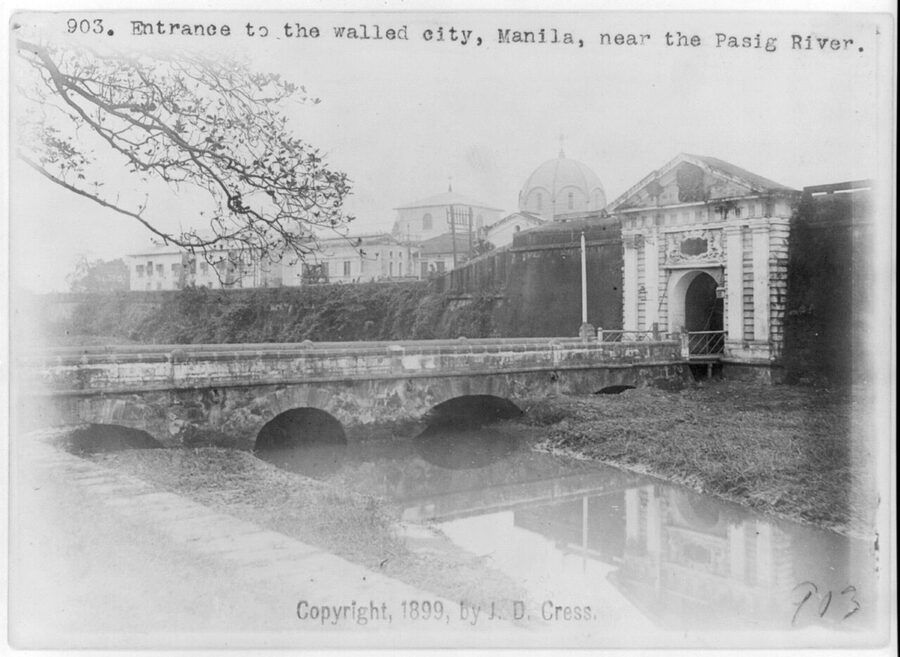
This is the section that ought to come early in any Intramuros guide and almost never does. From 3 February to 3 March 1945, Manila was the site of the only major urban battle of the Pacific war. The Japanese commander, Vice Admiral Sanji Iwabuchi, was ordered to abandon the city. He refused. About seventeen thousand Japanese marines dug in inside Intramuros, the Manila Hotel, and the government buildings around Rizal Park.
The American assault took twenty-nine days, house by house. The Japanese carried out systematic massacres of trapped Filipino civilians: at the German Club, the De La Salle College chapel, San Agustin Church, Fort Santiago. The American shelling hit anything still standing. Between one hundred thousand and one hundred and twenty thousand Filipino civilians died. San Agustin was the only major church inside the walls left standing. The cathedral was gone. Six other Spanish-era churches were gone. The colonial city of three centuries was destroyed in one month.
The Memorare Manila monument by Plazuela de Santa Isabel, on General Luna near San Agustin, is a small bronze pieta for the civilian dead. Stand in front of it for a minute. Read the inscription.
The Walls and the American Demolition
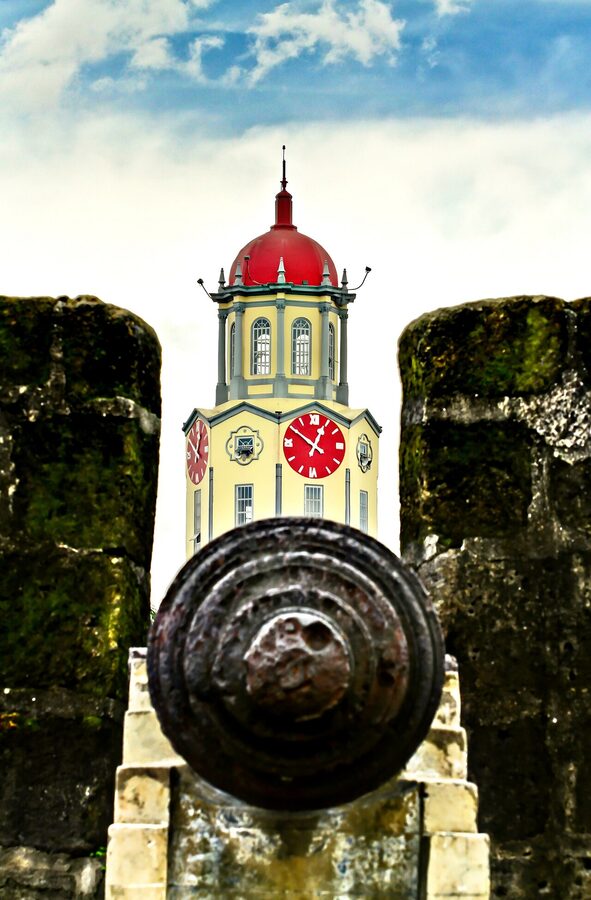
The walls used to have a working moat. After taking the Philippines from Spain in 1898, the Americans decided in 1903 the moat was a malaria hazard. They filled it in and turned the south and east sides into a golf course (the Intramuros Golf Course is still there, eighteen holes laid over what used to be the city’s defensive moat). They also tore down a long stretch of the eastern wall to widen Bonifacio Drive. The lost walls were never rebuilt. So when you walk the surviving western and southern stretches, you’re walking on stone that’s been there since Legazpi.
Skip This / Don’t Skip
Skip the overcharge kalesa. ₱350-500 is the right number. Anything starting at ₱1,500 is the scam.
Skip Casa Manila if you’re tight on time. The San Agustin Museum next door fills the same slot with much more depth.
Don’t skip the Rizal Shrine. Most foreign visitors don’t know who Rizal is when they walk in and they leave understanding why every Philippine town has a square named after him.
Don’t skip the San Agustin Museum. Visitors who do the church (free) and assume they’ve done the museum (₱200) miss the best room in Intramuros. The cloister upstairs alone is worth the entry.
Don’t skip Baluarte de San Diego. Lonely, weird, almost empty, with a buried-then-rediscovered ruin in the middle.
Don’t skip the dungeons, even though you’ll want to. The history of Intramuros doesn’t make sense without them.
What to Pair It With
If you have a full day in this part of Manila, pair Intramuros with Rizal Park (ten minutes on foot from Baluarte de San Diego, free, with the Rizal Monument standing where he was shot) and a Binondo dinner. This fits cleanly into Day One of our three-day Manila itinerary. For the wider picture, see things to do in Manila and where to stay in Manila. Shortest answer on basing yourself: stay in Makati or BGC and plan a half-day cab to Intramuros. The Manila Hotel is the one exception, and staying there is itself a piece of the heritage visit.
Frequently Asked Questions
How long does Intramuros take to see properly?
A half day if you read the markers and do one museum. A full day if you do both museums, Casa Manila, and a meal. The two-hour stop most guides suggest is the speed-walk version: you’ll see the gate, you won’t see the place.
Is Intramuros safe to walk?
Yes. There’s a visible police presence at the main gates and around the major sites. Pickpocketing happens; keep your phone in a zipped pocket. After dark, stick to General Luna and the river promenade.
Can I do Intramuros without a guide?
Yes. The Intramuros Administration map is free at every site, plaques are in English, and the place is small enough to walk in a morning. DOT-accredited walking guides and Bambike tours cost ₱600-1,200 if you want one. The free weekend tour run by intramuros.gov.ph is also good.
What is the fair price for a kalesa ride?
₱350-500 for a thirty- to forty-minute loop. Drivers often quote ₱1,500 or more to tourists. Walk away and find another driver.
What should I wear?
Closed shoes, light cotton, a hat. Both churches enforce modest dress: shoulders covered, no visible thighs. They keep wraps at the entrance for tourists who didn’t get the memo.
Can I visit Intramuros at night?
Fort Santiago is open until 10pm. The cathedral closes at 6pm. The Pasig River promenade is pleasant after sunset. Walking the wall alone at 10pm is not advised.
How much should I budget?
Entrance fees: ₱425 if you do all four ticketed sites. Add ₱400 for one kalesa ride or a Bambike tour. Add ₱500-800 for lunch and a drink. Total roughly ₱1,400-1,800 (~$25-32) per person, before transport.