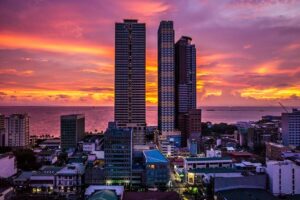
The bell at San Agustin starts ringing just as the sun goes red over Intramuros. The cobbles still hold the day’s heat, and a kalesa clops past with the driver half asleep, his horse picking the route home from memory. Two priests cross the plaza with their cassocks pulled up to keep them off the puddles. A guy with a Bluetooth speaker on the back of a Bambike pedals by, blasting OPM. This is the Manila I keep coming back to, and it is also the Manila most one-day visitors miss. They land at NAIA, fight EDSA traffic to a hotel in Makati, see a mall, and leave wondering what the fuss is about.
This article contains affiliate links to Klook, Booking.com, and other partners. If you book through them I earn a small commission at no extra cost to you. Every recommendation here is mine, paid or not. I would not send you somewhere I would not send a friend.

This is the anchor guide to Manila for people who actually want to walk it. Eighteen sections, four neighbourhoods, one contrarian list of things to skip, and a by-time-of-day cheat sheet at the end. I have grouped things by theme rather than ranked them 1 to 25, because the right “best” depends on whether you came for the history, the food, the nightlife, or the kids. If you have only just landed and have not figured out where to base yourself, the area-by-area hotel breakdown answers that first.
In This Article
- Walking Old Manila: Intramuros and the Walled City
- Take a kalesa or a Bambike, not both
- San Agustin Church: the only thing that survived 1945
- Manila Cathedral and the Plaza Roma
- Fort Santiago and the Rizal cell
- Museums and the Quiapo Market Crawl
- The National Museum complex (and Spoliarium)
- Ayala Museum: Manila’s best private collection
- Quiapo: the basilica, the market, the underbelly
- Binondo: the world’s oldest Chinatown
- Eat Like Someone Who Lives Here
- Poblacion food crawl
- Modern Manila: Makati and BGC
- Greenbelt and the Ayala Centre
- BGC: the part of Manila that does not feel like Manila
- Blackbird at Nielson Tower
- Quirky and Sleeper Picks
- Escolta on a Saturday
- Calle Carriedo and the Hidalgo camera shops
- Cubao Expo
- FEU’s Filipiniana art collection
- The Cultural Center of the Philippines
- Destileria Limtuaco Museum
- For Families
- Manila Ocean Park
- The Mind Museum
- The Bay, the Sunset, and the Late Night
- Greenhills (skip the malls, hit the tiangge)
- Things to Skip in Manila (or Approach with Lower Expectations)
- Best Manila Things to Do, by Time of Day
- Getting Around Without Losing Your Mind
- Where to Base Yourself
- Day Trips Worth the Drive
- FAQ
- How many days do you need in Manila?
- Is Manila safe for tourists?
- What is the best time of year to visit?
- Do I need cash, or do cards work?
- Can I drink the tap water?
- Is Mall of Asia worth a trip?
- How much should I budget per day?
- One Last Thing
Walking Old Manila: Intramuros and the Walled City

Intramuros is the original Manila. The Spanish founded it in 1571, walled it in stone, and ran the colonial capital from inside its 0.67 square kilometres for the next three centuries. Almost every brick was flattened in the 1945 Battle of Manila when American shelling and Japanese street-fighting reduced it to dust. What you see today is partly original, partly reconstruction, partly active restoration that has crept along since the 1980s. It is the only walkable historic quarter in Metro Manila, which makes it both the obvious thing to see and the thing most people see badly.
Start at Plaza Roma between Manila Cathedral and the old Ayuntamiento, and just wander. Bring water. There is no shade strategy that works for the noon heat, so go either before 10am or after 3:30pm. Cobblestones plus rubber slippers equals blisters; wear real shoes. The deeper guide to the walking route, with the Plaza San Luis stop and the Baluarte de San Diego garden detour, sits in the dedicated Intramuros walking guide.
Take a kalesa or a Bambike, not both

The kalesa (horse-drawn carriage) ride around Intramuros is touristy and I love it. It is also the one thing where you have to haggle hard, because the asking price is always inflated. ₱350 to ₱500 for a 30-minute loop with two stops is the going rate. The drivers will start at ₱1,500. Smile, walk away, they will lower it. Don’t take it from the Manila Cathedral side where the buses unload; the Casa Manila corner has fairer pricing because the drivers there compete for repeat customers.
If you would rather pedal, Bambike Ecotours rents bamboo bicycles built by a Gawad Kalinga social enterprise. The 2.5-hour guided tour is ₱1,200 (~$21) per person and starts near Casa Manila. You get a guide who actually knows what each ruined wall used to be, plus the bike is genuinely fun to ride. Pre-book on Klook or GetYourGuide; walk-ins do work but the morning slot fills up fast.
San Agustin Church: the only thing that survived 1945

San Agustin Church is the oldest stone church in the Philippines, finished in 1607, and the only Intramuros structure that survived the 1945 destruction intact. UNESCO listed it in 1993 as one of the four Baroque Churches of the Philippines. Inside, the trompe-l’oeil ceiling alone is worth the visit; two Italian artists painted the entire vault flat in 1875 to make it look three-dimensional, and from the right angle it still works. The hand-carved Mexican-baroque pulpit is the kind of detail tour groups miss because they are looking up.
The attached San Agustin Museum (₱200, ~$3.50) is the underrated half. It is housed in the former monastery, and the cloister, the choir loft above the church, and the gallery of religious-art pieces salvaged from across the archipelago are the most peaceful rooms in old Manila. Allow 90 minutes. Closed Sundays for the museum, open during church hours.
Manila Cathedral and the Plaza Roma

The Manila Cathedral you walk into now opened in 1958, after the 1945 levelling. Eight cathedrals have stood on this site since 1581 and all but the current one came down to disasters. Entry is free, the doors close around 6pm, and Sunday mass is in English at noon. The cathedral organ has 4,500 pipes and is one of the few in the world with the bellows still hand-pumped on certain feast days. If you can time a free organ recital (usually Friday lunchtime, schedule pinned to the side door), do.
Fort Santiago and the Rizal cell

Fort Santiago anchors the northwest corner of Intramuros where the Pasig River meets Manila Bay. The Spanish built it on top of a pre-colonial Tondo settlement in 1593, and the Americans, the Japanese, and the Philippine government have all used it since. The big draw now is the Rizal Shrine inside the citadel: this is where Dr José Rizal was held the night before his execution in 1896, and his final cell, his desk, his shoes, and the original manuscript of “Mi Último Adiós” are on display. Entry is ₱75 (~$1.30), open 8am to 7pm daily. Aim for the last 90 minutes before close, when the gardens are empty and the late light hits the stone.
The newer addition I tell everyone about: Papa Kape, a tiny cafe tucked inside the Aljibe de la Fuerza, a 400-year-old Spanish water cistern below the fort grounds. Coffee with grass jelly, mango sampalok iced tea, and a ceiling of arched stone older than most countries. Easy to miss; the entrance is signposted near the inner courtyard.
Museums and the Quiapo Market Crawl
The National Museum complex (and Spoliarium)

The National Museum of the Philippines is three buildings clustered on the north side of Rizal Park, all of them free. This is the single biggest deal in Manila that does not get its due in most travel guides. Start at the National Museum of Fine Arts on Padre Burgos Avenue, where Juan Luna’s Spoliarium hangs at the end of the central hall: 4.22 by 7.67 metres of dying gladiators that won gold at the 1884 Madrid Exposición Nacional and basically launched Filipino visual art onto the world stage. The painting is overwhelming in person. There is a bench across from it; sit down.
Cross to the National Museum of Anthropology for the Manunggul Jar (the 1,000 BC burial jar with the boatmen on the lid is on the ₱1,000 note for a reason), the Tabon Cave fossils, and an entire wing on Cordillera weaving traditions that nobody else covers. The third building, the National Museum of Natural History, has a glass elevator inside a “Tree of Life” sculpture that runs up six storeys. Kids love it. So do I, and I am not a kid. Open Tuesday to Sunday, 9am to 6pm. Bring ID; the entry is free but they want to log it.
Ayala Museum: Manila’s best private collection

The Ayala Museum sits at Greenbelt Park in Makati and is the richest private museum in the country. The “Gold of Ancestors” gallery has more than a thousand pre-colonial gold objects (10th to 13th century) excavated from sites in Surigao and Mindoro. The 60 hand-carved dioramas of Filipino history on the second floor are the kind of thing schools used to do well; they still do here. Entry ₱425 (~$7.50), closed Mondays, open 9am to 6pm. The museum recently added an augmented-reality layer and Braille booklets for accessibility, which I appreciate.
Quiapo: the basilica, the market, the underbelly

The Minor Basilica of the Black Nazarene (everyone just says Quiapo Church) is the spiritual centre of working-class Manila. The dark wooden statue of Christ inside, the Black Nazarene, has been venerated since 1606, and the annual Traslación procession on January 9 sees five to six million people walk it through Quiapo in one of the largest religious gatherings on earth. If you are anywhere near Manila that week, watch from a building, not the street. Any other day of the year, walk in, light a candle, then step outside and let the neighbourhood happen to you.

Behind Quiapo Church is Quinta Market, sprawling north toward the Pasig River. Carlos Palanca and Hidalgo streets fan out from there with stalls selling herbal medicines, anting-anting amulets, candles in primary colours, and pirated DVDs that have somehow survived the streaming era. This is also where the city’s street food crawl picks up real momentum: kwek-kwek (orange-battered quail eggs), isaw (chicken intestine BBQ), taho (warm tofu pudding with sago and dark caramel) at sunrise. Solo travellers, particularly women, should keep a Grab booked on the way out. The neighbourhood is fine in daytime and tightens up after dark.
Binondo: the world’s oldest Chinatown

Binondo was established in 1594 by the Spanish for Catholic Chinese immigrants, which makes it the oldest Chinatown in the world. It has been an unbroken food neighbourhood for 430 years. The grid is small (you can walk it end to end in 25 minutes) but the layering is dense. Worth knowing the names: Dong Bei Dumplings on Yuchengco, the kuchay (chive) dumplings hand-folded in the front window for ₱200 a basket. New Po-Heng on Quintin Paredes for the lumpiang Shanghai, ₱70 a roll. Eng Bee Tin’s hopia (mung-bean pastry) shop on Ongpin, the original branch since 1912. Apologue, a third-wave coffee place tucked off Salazar, where the espresso is the best in old Manila by a margin. Grand Cafe 1919 if you want air-con and a sit-down; it is in a beautifully restored century-old colonial building.
If you do not feel like reading street signs in Hokkien, the Old Manila Walks Big Binondo Food Wok with Ivan Man Dy (3.5 hours, ₱1,600 per person, ~$28) is the right spend. Ivan was on Anthony Bourdain’s Manila episode. He is excellent. Book on Klook. Skip the cheaper food tours that pile you onto a jeepney with 20 other people. The point of Binondo is the alleys, not the AC.
Eat Like Someone Who Lives Here

Filipino food is having a global moment that has somehow not landed in Manila as obviously as it has in New York or London. Toyo Eatery, Hapag, Metiz, Manam, Sarsa: the modern Filipino tasting-menu scene here can stand against anything in Bangkok or KL, and a tasting menu at Toyo runs around ₱4,500 (~$78), which would be three times that in either of those cities. Toyo’s Bahay Kubo plate (a single dish that includes all 18 vegetables from the folk song) is the one to order. Reserve two weeks out for weekends.
For everyday Filipino, Manam’s Ayala Triangle flagship is the easy answer. Sisig, kare-kare, sinigang, halo-halo, all customisable in three sizes; expect ₱600 to ₱800 (~$10-14) per person with drinks, and the seating overlooks Ayala Triangle Gardens, one of the only proper green spaces in Makati. The deeper restaurant breakdown lives in the where-to-eat guide; treat this as the headline.

One specific dish, one specific place: halo-halo at Razon’s of Guagua. Razon’s is from Pampanga but the Manila branches (BGC, Greenbelt, Mall of Asia) serve the proper Pampanga-style halo-halo, which has only three ingredients (macapuno, leche flan, sweetened banana) in milk-based shaved ice instead of the usual everything-in-the-fridge version. Cleaner, milkier, far better. ₱180 (~$3.20). It is the halo-halo I argue with my Manila-side friends about.
Poblacion food crawl

Poblacion is the Makati neighbourhood that bar-and-restaurant magazine writers cannot stop praising and locals quietly resent for becoming overrated. Both reactions are fair. The good Poblacion crawl, in order, on a Friday night: start at Polilya for craft beer (₱180-220, ~$3-4 a pour) on Felipe Street; walk one block to Agimat at Ugat for cocktails inspired by Filipino mythology (the Aswang is the order); cross to Spirits Library on Don Pedro for a quieter back-bar with one of the best whisky walls in the country; finish at Bank Bar (you have to ask the receptionist at the building’s lobby for “the bar,” it is unmarked) for a 1am cocktail. Most rooms here close by 2am on weeknights, 3am on weekends. A full Manila nightlife guide covers the rooftops and the dive bars too; the Poblacion crawl is the entry point.
Modern Manila: Makati and BGC
Greenbelt and the Ayala Centre

Manila is a mall city. Insulting that fact will not make it less true. Greenbelt and the connected Glorietta complex in Makati’s Ayala Centre is the headline mall, but the redeeming detail most visitors miss: the chapel of the Santo Niño de Paz between Greenbelt 3 and Greenbelt 5, an open-air glass-walled chapel surrounded by koi ponds and frangipani trees. It is one of the only quiet places in Makati with no cover charge. Catholic services run hourly Sundays. Walk in any other time and just sit. The malls themselves are useful for exactly two things: AC during a 2pm thunderstorm, and refilling on toiletries before you fly to a province where Boots is a person’s name.
BGC: the part of Manila that does not feel like Manila

Bonifacio Global City is the most planned, gridded, and pavement-having neighbourhood in Metro Manila. It does not feel like the rest of Manila and that is exactly the point. Walk Bonifacio High Street north-to-south end-to-end (about 25 minutes), then loop back along 5th Avenue. The street art is the unsung attraction: more than 60 large-format murals scattered through the office-tower walls, mapped by the BGC Arts Center; my favourites are the Egg Fiasco wall on 26th Street and the Anina Rubio mermaid on 5th. Hub:Make Lab and Mind Museum are inside the same complex. BGC hotels get into the weeds on whether to actually stay here, which is a real question because the answer depends on what you came for.
Blackbird at Nielson Tower
Worth a mention on its own: the 1937 Nielson Tower in the middle of Ayala Triangle was Manila’s first international airport’s control tower, and the runways became the avenues that now name Makati’s grid (Ayala Avenue, Makati Avenue, Paseo de Roxas). Blackbird, the bar-and-restaurant inside the tower, kept the original art deco bones and added a kitchen that punches well above the touristy-locale price tag. Cocktails ₱650-850 (~$11-15). Reserve. Sunset from the tower terrace at 6pm is one of the best in Makati.
Quirky and Sleeper Picks
Escolta on a Saturday

Escolta was Manila’s Wall Street and Madison Avenue rolled into one block from the 1890s through the 1960s. The Calvo Building, the First United Building, the Regina Building, and the Burke are all still there in faded art deco glory, half restored and half hanging on. The First United Building hosts the monthly Saturday Block Festival on the first Saturday, when artists, zinemakers, vintage clothing dealers, and local chefs take over the ground floor. The HUB: Make Lab on the same floor sells Filipino indie design year-round. Combine with Binondo (10 minutes by foot) and you have a half-day of old-Manila urbanism that 90% of guidebooks skip.
Calle Carriedo and the Hidalgo camera shops
Hidalgo Street in Quiapo is the world’s only camera-shop alley I know of where you can buy a working 1962 Leica and a roll of Kodak Gold from the same vendor. The street has been the Manila photographer’s row since the 1950s. Even if you do not collect, walk it. Nostalgia is cheap entertainment. Calle Carriedo runs perpendicular and ends at the LRT-1 Carriedo station, which is itself a bit of urbanism worth seeing: this is the original American-period rail line, and the station retains the raised open-air platform from 1984.
Cubao Expo

Cubao Expo (also called Marikina Shoe Expo, originally a 1970s shoe-trading hub) is a horseshoe of one-storey shops in Araneta City, Quezon City, that became the indie-hipster outpost when Poblacion got too expensive. Fred’s Revolución for whisky and live folk; Mow’s for the basement gigs (Up Dharma Down used to play here); Vinyl Dump for second-hand records. Most shops open 4pm onward. Grab from BGC ₱220-300, from Makati ₱180-260. Tuesdays are dead; Fridays and Saturdays are why you came.
FEU’s Filipiniana art collection
Far Eastern University on Nicanor Reyes Street in Sampaloc is a 1934 art deco campus, declared a UNESCO Heritage Award winner in 2005, with a collection of Filipiniana paintings (Botong Francisco, Vicente Manansala, Hernando Ocampo) that almost nobody outside the university knows about. The president’s office gallery and the FEU Art Gallery rotate them. Free, weekdays only, security will let you in if you ask politely at the gate and mention the gallery. Allow an hour. Walk the campus afterwards; it is one of the most coherent pre-war architectural ensembles still standing in Manila.
The Cultural Center of the Philippines

The CCP complex on Roxas Boulevard was Imelda Marcos’s crown architectural project, a Brutalist cantilevered slab built in 1969 by Leandro Locsin. The main building has been under heavy renovation since 2023 and the schedule has slipped twice already, so check before you go. The smaller venues (Tanghalang Aurelio Tolentino, the Black Box) keep programming Ballet Philippines, Tanghalang Pilipino, and the Cinemalaya independent film festival every August. Even if you do not catch a show, the building is worth a look from the outside as a piece of dictator-era architecture history. Bay-side at sunset, walk the breakwater, you have got an hour killed.
Destileria Limtuaco Museum
Tucked into a stone house in Intramuros, the Destileria Limtuaco is the country’s oldest distillery (1852) and turned its own history into a small but fun walkthrough museum. Entry ₱150 (~$2.70); the optional tasting (sugarcane wine, coconut vodka, lambanog infused with calamansi) is another ₱350. Closed Mondays. Pair with San Agustin and you have your morning sorted.
For Families
Manila Ocean Park

Manila Ocean Park sits behind the Quirino Grandstand and the Hotel H2O, on reclaimed land facing the bay. The Oceanarium itself (the original 2008 attraction) is the worth-it part: a 25-metre walk-through acrylic tunnel through the ray and shark tank, plus the jellyfish gallery. The bolt-on attractions (Trails to Antarctica, Sea Lion Show, Pavilion) are skippable unless you have actual children with you, in which case you will find yourself doing all of them. Standalone Oceanarium ticket ₱700 (~$12), All-Access pass ₱1,490 (~$26). Open daily 10am to 8pm. Klook bundles save about ₱200 versus walk-up pricing.
The Mind Museum
The Mind Museum in BGC is a hands-on science museum aimed at kids 6 to 14. Five galleries (Atom, Life, Earth, Universe, Technology) plus a science park outside. The all-day pass is ₱825 adult, ₱625 child, lower midweek. The exhibits are properly maintained, which I cannot say for every Manila museum. Go midweek mornings if you can; weekends fill with school field trips and the queue at the magnetic-fields station eats half your visit.
The Bay, the Sunset, and the Late Night

The Manila Bay sunset is the most overhyped attraction in the city and also worth showing up for, which is a paradox I have stopped trying to resolve. The bay water itself is dirty, the rehabilitation programme is ongoing, and the dolomite beach the government built in 2020 was controversial when it opened and remains so. None of that matters when the sun goes down and the sky goes pink-orange-deep-red over the South China Sea silhouettes of cargo ships. Park yourself on the baywalk in front of the US Embassy by 5pm. Bring a cold San Mig from a nearby 7-Eleven; nobody minds. The sun is below the horizon by 6:15pm year-round in this latitude.
For the rooftop version: Sky Deck at the Bayleaf Intramuros (rooftop bar, ₱200 cover that doubles as a drink credit, opens 5pm) gives you the bay sunset and the Intramuros lights at the same time. For the bay-side dinner version: the al fresco terraces along Mall of Asia’s Seaside Boulevard are tourist-flavoured but they get the sunset live and the bucket of San Mig is ₱650 for six bottles.
Greenhills (skip the malls, hit the tiangge)
Greenhills Shopping Center in San Juan is the bargain hunter’s market, and it is where Filipino expats brief visiting cousins to go for pearls. Real pearls (the South Sea kind) can be picked up at the legitimate stalls (ask for the Pearl Center on the third level) at a third of US prices; you have to know what you are looking at. The Greenhills tiangge stretches across half the complex and sells phones, fakes, sneakers, K-pop merchandise, and proper local jewellery. Bring cash. Bargain. Most stalls open 11am to 9pm.
Things to Skip in Manila (or Approach with Lower Expectations)
Some calls for the contrarians.
Manila Ocean Park’s bolt-on attractions. The Oceanarium is good. The Trails to Antarctica diorama and Symphony Lights show are forgettable, and the All-Access pass quietly steers you into them. Buy the standalone Oceanarium ticket and call it a day.
The Dessert Museum at Mall of Asia. ₱699 to walk through eight Instagram-bait rooms. Skip unless you have a 12-year-old who will be ruined if denied a ball-pit selfie. The Mind Museum gets you actual science for the same money.
Mall of Asia for anything except the sunset. It is the third-largest mall in the Philippines and feels like every other mall in the world. The Globe Maker Lab and the Manila Bay-facing al fresco strip are the only reasons to come. Otherwise, Greenbelt is better, BGC’s High Street is more interesting, Robinsons Magnolia is more local. The MOA Eye Ferris wheel is fine. It is also a Ferris wheel.
The “Manila Tour” hop-on hop-off bus. The bus exists, the routes are fine on paper, the traffic kills it. You will spend 60% of your tour on the upper deck breathing diesel. Use Grab and a self-built itinerary; you will see twice as much.
Resorts World casinos and “entertainment city” generally. Solaire, Okada, City of Dreams: these are the fanciest hotels in the country and the casinos under them are a global standard of glitz. They are also a 40-minute Grab from anything else worth seeing. Worth a meal or a show. Not worth a base. The luxury-hotel breakdown in Manila’s best luxury hotels covers them in detail.
Roxas Boulevard ihaw-ihaw stretch after midnight. The grilled-meat strip along Roxas south of CCP gets recommended by guidebooks that have not visited recently. It is a different scene now, food-safety-wise, and a Grab from there at 1am is harder than it should be. Eat in Poblacion or Binondo and you get the same food in better hands.
Best Manila Things to Do, by Time of Day
Morning (6am to 10am). Fort Santiago when the gardens are empty and the gate light is gold. The National Museum complex from 9am sharp; you will have the Spoliarium hall to yourself for 20 minutes. Quinta Market in Quiapo if you came for noise. Taho from a roving vendor.
Midday (10am to 3pm). Stay indoors. Ayala Museum in Makati. Mind Museum in BGC. Lunch at Manam (Ayala Triangle), Toyo Eatery (reservation-only), or anywhere in Binondo. The San Agustin Museum if you walked Intramuros in the morning.
Late afternoon (3pm to 5:30pm). Intramuros walking loop. Bambike tour. Casa Manila. Saturday block parties at Escolta if it is the first weekend of the month. Coffee at Papa Kape inside Fort Santiago.
Sunset (5pm to 6:30pm). Manila Bay baywalk in front of the US Embassy. Sky Deck at the Bayleaf for the rooftop version. The Mall of Asia Seaside terraces if you want to drink while watching. Blackbird at Nielson Tower for the Makati spin.
Evening (6:30pm to 11pm). Dinner in Poblacion (Manam, Toyo, or Mesa) or Binondo (Wai Ying for Hong Kong-style, Lan Zhou Lamian for hand-pulled noodles). Cocktails at Agimat at Ugat. Live music at 19 East (BGC) or Mow’s (Cubao).
Late night (11pm to 3am). Bank Bar (the unmarked one in Makati). Spirits Library. The Curator. If you came to dance, the clubs around Burgos Street in Poblacion run latest. Grab gets surge-priced; budget ₱400-700 home.
Rainy day. Manila has rainy season June through November and afternoon thunderstorms in any month. The good rainy-day options are the National Museum complex, Ayala Museum, the connected mall complexes (Greenbelt to Glorietta to SM Aura is all under cover via skywalks), and any one of the modern Filipino restaurants where you can sit for three hours.
Getting Around Without Losing Your Mind

Grab is the answer 90% of the time. App-based, capped fares, no scams, the surcharge during rush hour is mildly annoying but not predatory. Typical fares: Makati to Intramuros ₱200-280; BGC to Binondo ₱280-380; NAIA to Makati ₱350-450. Surge after 5pm and during rain can double those. Add 10-30 minutes of buffer for traffic on weekday afternoons. The MRT-3 along EDSA is fast and brutal at peak hour. The LRT-1 from Roosevelt to Baclaran is useful for Quiapo (Carriedo station) and Mall of Asia (EDSA station). Ride a jeepney once, on a short route, just to say you did. Skip taxis, buses, and any unmarked car offering you a “tour.”
The full transport breakdown is in the getting around guide; the key thing here is that picking the right thing to do also means picking the right time to do it, because what looks like a 4km trip on the map can be a 90-minute Grab if you mistime EDSA.
Where to Base Yourself
Quick orientation, since “where in Manila” is the thing that breaks first-timers. Makati is the safe pick: walking distance to Greenbelt, easy Grab to anything else, the most hotels at every price point. BGC is calmer, gridded, more international, less local-feeling. Intramuros has the Manila Hotel and almost nothing else; you will Grab in and out a lot. Pasay is for early flights only. Quezon City is too far north for most three-day visitors. The full where-to-stay area breakdown covers each, and if budget is the question, the budget hotels and hostels guide has 38 properties under ₱3,500 a night.
Day Trips Worth the Drive
If you have four days or more, the day-trip menu is what makes Manila worth using as a base. Tagaytay (Taal Volcano view, 2 hours south), Pampanga (the country’s best food, 90 minutes north), Corregidor (WW2 island fortress, ferry from CCP, 90 minutes), Anilao for diving (3 hours south), Las Casas Filipinas heritage village (2.5 hours north). Each of these is enough for a full guide of its own. The day trips from Manila guide has the full breakdown of how to choose, with realistic transport costs and what to skip.
FAQ
How many days do you need in Manila?
Three full days. One for Old Manila (Intramuros, the National Museum, Binondo, Manila Bay sunset). One for Modern Manila (Makati or BGC, Poblacion at night). One day-trip (Tagaytay or Pampanga). A three-day itinerary with timings and Grab fares is in the planner article.
Is Manila safe for tourists?
Yes, with normal big-city caution. Stick to Grab after dark, do not flash phones in jeepneys, do not argue with strangers offering tours. Makati, BGC, Intramuros (in daylight), and Poblacion are fine. Some parts of the City of Manila proper get rougher at night; Quiapo after sunset, parts of Tondo, parts of Pasay near the port. If a neighbourhood feels off, it is. Trust that.
What is the best time of year to visit?
December to February. Cooler (24-30°C), drier, low humidity. March to May is hot (regularly 35-40°C) and humid. June to November is rainy season, with serious typhoons typically peaking August to October. December has the Christmas decorations up across the city, which is a thing in the Philippines and worth catching.
Do I need cash, or do cards work?
Both. Cards work at malls, hotels, and most restaurants. Cash is essential for jeepneys, kalesa rides, market stalls, taho vendors, and almost every smaller business in Quiapo, Binondo, and Escolta. ATMs are everywhere; the BPI and BDO ones are the most reliable. Money changers in Makati (Czarina, Sanry’s, the ones in Glorietta) give 10-20% better rates than the airport.
Can I drink the tap water?
Filipinos do not. Stick to bottled or filtered. Hotels above three stars usually have filtered water on tap or a refill station; take advantage. Ice in malls and proper restaurants is fine; ice from a streetside cart is not.
Is Mall of Asia worth a trip?
For the sunset on Seaside Boulevard, yes. For the shopping, no, unless you specifically want to compare three branches of the same chain in air-conditioning. Greenbelt or BGC’s High Street is more interesting.
How much should I budget per day?
Backpacker, ₱2,500 (~$45) per day including dorm bed and street food. Mid-range, ₱5,500 (~$96) including a 3-star hotel, mall lunches, and mid-range dinners. Higher end, ₱14,000 (~$245) and up for 5-star hotels and full Grab everywhere. Drinks add up fast: ₱220 cocktails in Poblacion, ₱650 at Blackbird.
One Last Thing

Manila is a hard sell when you compare it to Cebu or Palawan or Siargao. It will not look like a postcard. The traffic is real, the heat is real, and the sprawl is real. What it has is layers: a 450-year-old stone city next to the world’s oldest Chinatown next to a sci-fi grid of skyscrapers, all in 25 minutes by Grab. If you give it three days and walk most of them, you will see why people who have lived here a long time forgive its rough edges. If you give it half a day and a hotel breakfast, you will leave thinking it is just an airport with a queue. Walk it. The list above is a starting kit.